
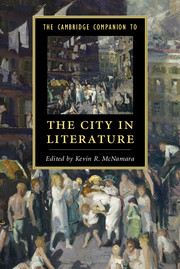
The Cambridge Companion to the City in Literature / edited by Kevin R. McNamara, University of Houston-Clear Lake.
Material type: TextSeries: Cambridge companions to literaturePublication details: Cambrigde, UK : Cambridge University Press; c2014.Description: xxvii, 286 pages ; 24 cmISBN:
 - 9781107028036 (Hardback)
- 9781107609150 (Paperback)
- 809/.93321732 23
- PN56.C55 C36 2014
- LIT004120
 Books
Books
| Cover image | Item type | Current library | Home library | Collection | Shelving location | Call number | Materials specified | Vol info | URL | Copy number | Status | Notes | Date due | Barcode | Item holds | Item hold queue priority | Course reserves | |
|---|---|---|---|---|---|---|---|---|---|---|---|---|---|---|---|---|---|---|
| Judith Thomas Library General Stacks | Books | PN 56 .C55 C36 2014 (Browse shelf(Opens below)) | AUA26152 | Available | AUA26152 |
Includes bibliographical references and index.
Machine generated contents note: Introduction Kevin R. McNamara; 1. Celestial cities and rationalist utopias Antonis Balasopoulos; 2. The city in the literature of antiquity Susan Stephens; 3. The medieval and early-modern city in literature Karen Newman; 4. The spectator and rise of the modern metropole Alison O'Byrne; 5. Memory, desire, lyric: the flâneur Catherine Nesci; 6. Social science and urban realist narrative Stuart Culver; 7. The socio-economic outsider: labor and the poor Bart Keunen and Luc de Droogh; 8. The urban nightspace James R. Giles; 9. Masses, forces, and the urban sublime Christophe den Tandt; 10. Fragment and form in the city of modernism Arnold L. Weinstein; 11. Cities of the avant-garde Malcolm Miles; 12. Urban dystopias Rob Latham and Jeff Hicks; 13. Postmodern cities Nick Bentley; 14. Colonial cities Seth Graebner; 15. Postcolonial cities Caroline Herbert; 16. The translated city: immigrants, diasporans, and cosmopolitans Azade Seyhan; 17. Gay and lesbian urbanity Gregory Woods; 18. Some versions of urban pastoral Kevin R. McNamara and Timothy Gray.
"From the myths and legends that fashioned the identities of ancient city-states to the diversity of literary performance in contemporary cities around the world, literature and the city are inseparably entwined. The international team of scholars in this volume offers a comprehensive, accessible survey of the literary city, exploring the myriad cities that authors create and the genres in which allegorical cities appear. Early chapters consider the literary legacies of historical and symbolic cities from antiquity to the early modern period, while subsequent chapters consider the importance of literature to the relationship between urban landscape and memory. These later chapters explore the form of the literary city and its response to social and technological change; dystopian, nocturnal, pastoral, and sublime cities; and the cities of economic, sexual, cultural, and linguistic outsiders"--